
Podcast: Download (Duration: 15:33 — 21.4MB)
Subscribe: Apple Podcasts | Spotify | Android | RSS | More
During Lent we often give things up and practice various forms of “discipline” and “asceticism.” The three traditional practices of prayer, fasting, and almsgiving are admirable undertakings for Lent. However, we have to also be careful that we don’t come to see all of our desires as potential dangers that need to be carefully controlled. Our desires are put there by God and he often uses them to draw us to himself.
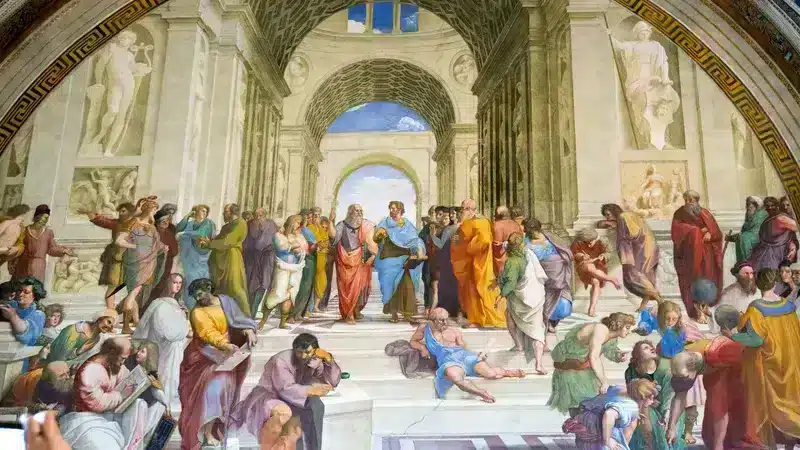
One of the famous paintings in the Vatican is entitled “The School of Athens” by Raphael. It features the two great Greek philosophers Plato and Aristotle in a seeming debate. Plato believed that you arrived at an understanding of reality by contemplating the ideal. You think of things primarily as ideas in their perfection. Aristotle, on the other hand, thought that we don’t experience our world primarily as an idea, but rather a concrete reality right in front of us. If you want to get to the higher ideas like Plato, then you start with the created world around you. For this reason, in the famous painting, Plato is pointing up to the sky and Aristotle is pointing down to the ground.
In today’s reflection, I look more at the path of Aristotle. Consider those desires I mentioned. These desires for created things are actually good. They can lead us to God. This is exactly what we see God doing in our readings from Mass today. God allows the Israelites to experience thirst in the wilderness so he could satisfy them with miraculous water from a rock. In the Gospel, the Samaritan woman is also thirsty and Jesus uses this to turn her thoughts to the ultimate thirst she has for God. In both cases, we should be able to conclude that, one… God knows our desires, and, two… he intends to fulfill them… ultimately by giving us himself.
The result of this understanding of desire is to see that our desires are created good and not to be feared. It is true that if we let our earthly desires merely lead us deeper into disordered dependence on earthly things we can fall into addiction and end up only looking at the ground as it were. But if we allow God to lead us and use our desires, then we can find God at the end of our desires just as the woman at the well did. Both Aristotle and Plato can end up in same place, with God… and so can we.